
PCdoB Renews Management System and Prepares Party for Electoral Challenges
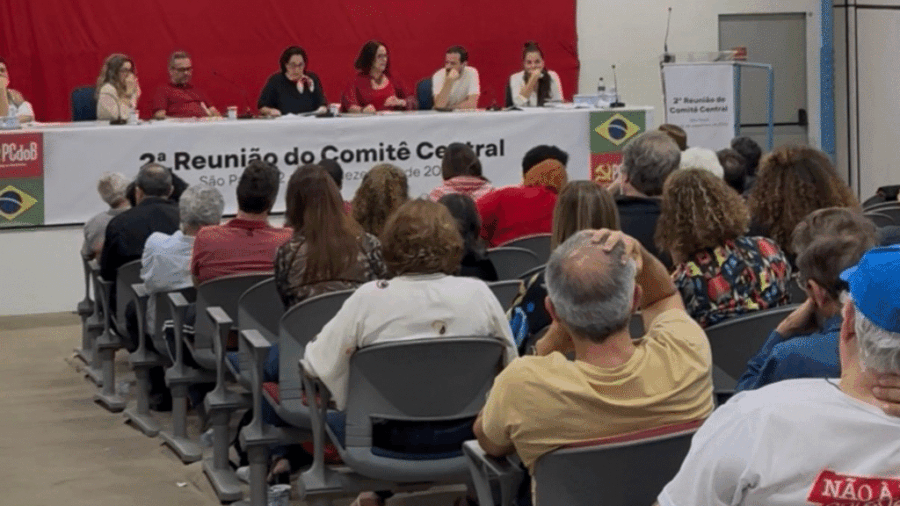
Meeting in São Paulo this past weekend, from December 12 to 14, the Central Committee of the PCdoB (CC) advanced in the composition of its National Management System for the period extending until 2027, encompassing the challenge of the upcoming electoral year in 2026. The decisions prepare the Party for the 2026 electoral challenge and reaffirm criteria for renewal, continuity, and the utilization of leadership from different generations. Overall, the new leadership seeks to respond to the diversity of the party’s work fronts, combining accumulated experience and political renewal to face the national and international scenario.
The meeting defined the composition of the Political Commission and the 20 members of the National Executive Commission. Vice-presidencies were also established, which will now be held by Carlos Batista Lopes and federal deputy Jandira Feghali (RJ). The Central Committee also approved the leave request of President Luciana Santos and elected the 1st Vice-President, Nádia Campeão, to exercise the presidency of the Party on an interim basis and to head the National Executive Commission, within the framework of the transition process agreed upon at the PCdoB’s 16th Congress.
The Central Committee elected the holders of the national secretariats, with changes and redefinitions of responsibilities in some areas of party activities. The new composition of the Control Commission was also defined, responsible for ensuring compliance with the Statutes, party ethics, and oversight of the accounts and assets of the party.
Nádia Campeão assumes interim presidency of the PCdoB
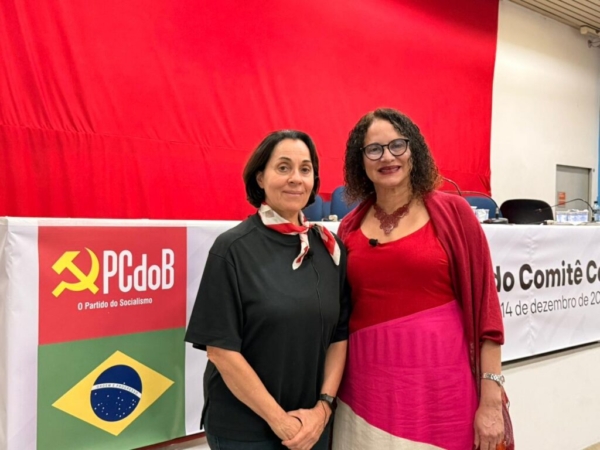
Nádia Campeão and Luciana Santos. Photo: Gabriela Brito
The meeting of the Central Committee confirmed the nomination of the 16th Congress, and Nádia Campeão assumed the interim presidency of the PCdoB. After ten years at the helm of the PCdoB, Luciana Santos is stepping down and will share leadership with Nádia Campeão, who assumes the interim presidency. In 2027, there will be a party conference to consolidate this process.
Luciana Santos explains that the decision is the result of a collective and mature process. “I have been at the helm of the PCdoB for ten years. At the last Congress, we had a strong debate, with a lot of cohesion, for Nádia Campeão to take over as first vice-president.”
According to her, it is a planned continuity. “I will remain president of the party until 2027, when we will hold a national conference to conclude this cycle. In the meantime, we think it is necessary to make a transition so that Nádia can take over and we can lead the party together,” she says.
Luciana points out that the main motivation is to prepare the PCdoB for the immediate challenges. “Together, we will lead the Party in next year’s most important battle, which is the electoral battle, whether for the reelection of President Lula or to strengthen the PCdoB’s bench in the National Congress.”
Nádia Campeão takes over with “enormous responsibility”
Upon assuming the interim presidency, Nádia Campeão emphasizes the political significance of the moment. “I accepted, with great responsibility, at the party’s 16th Congress, the nomination to be the first national vice president. That, in itself, already represents an enormous responsibility,” she says.
A PCdoB activist since 1978, Nádia highlights the personal and collective significance of the new undertaking. “I have already fulfilled many tasks in the party, but this is undoubtedly the one with the greatest responsibility. I take on this mission wholeheartedly,” she declared.
Nádia makes a point of valuing the legacy of the current president. “The work that Luciana has been doing all these years is very powerful. She has given our party a very strong visibility on the national scene,” she said, citing the coordination between the PCdoB presidency and Luciana’s work at the Ministry of Science, Technology, and Innovation. “We will continue on this path in a joint and shared effort. Our PCdoB will be the winner.”
Political priorities and active militancy
Luciana Santos points out that “our great challenge next year is to face a strategic and decisive struggle for the country and for democracy.” For her, the reelection of President Lula is central. “It is the struggle for the inclusion of the Brazilian people, for an agenda of growth, and for the victory of President Lula.”
Luciana also emphasizes the importance of expanding the communist presence in Parliament. “We need a very strong bench in the National Congress for our glorious PCdoB, so that we can be more influential and help in decisions about the direction of the country,” she said. In addition, she points out the fundamental importance of the programmatic debate, which will be conducted by the Maurício Grabois Foundation. “We will distribute tasks, share responsibilities, and successfully navigate this period.”
Electoral challenges and social struggles
For Nádia Campeão, the central focus of next year’s elections is the Presidency of the Republic. At the same time, she highlights the need to strengthen the progressive camp in the states and in Congress. “We will fight hard to expand the communist bench and advance in the National Congress.”
Nádia also points out that the political calendar will be marked by important social struggles. “We will have important battles, such as the fight to end the 6-to-1 scale, in addition to an intense year of party restructuring, affiliations, and political activities.” According to Nádia, these fronts are directly linked to the electoral process. “Without a doubt, the electoral battle will be a high priority until November.”
With the transition underway, the PCdoB is betting on a combination of political continuity, renewal of tasks, and internal unity to face a decisive period in Brazilian politics and party building.
Who is Nádia Campeão
The new acting president of the PCdoB, Nádia Campeão, is from Rio Claro, São Paulo, where she was born in 1958. She graduated in Agricultural Engineering from Esalq/USP and joined the PCdoB in 1978, at the age of 20.
Nádia was state president of the PCdoB-MA and PCdoB-SP. A member of the Party’s Central Committee since 1988, she headed the national secretariats for Institutional Relations and Organization. At the 16th National Congress of the PCdoB in October, she was elected vice president.
Her biography includes several positions in public office, parliamentary advisor, municipal secretary of sports, secretary of education, and deputy mayor of São Paulo during Fernando Haddad’s administration (2013-2016).
The communist leader has a postgraduate degree in Public Management. In 2019, she launched the book “Democratic Cities – The Experience of the PCdoB and the Left in City Halls (1985-2018)”.
Beyond organizational decisions, the meeting promoted a broad debate on the national and international political situation. The meeting pointed out the main actions of the PCdoB for the coming year, with emphasis on the 2026 electoral battle, considered central to the defense of democracy, the strengthening of the progressive field, and the expansion of communist representation in institutions.
Check out the list of composition of party bodies:
Political Commission
Adalberto Alves Monteiro
Adilson Gonçalves de Araújo
Alice Mazzuco Portugal
Altair Alves de Freitas
Alzimara Cabreira Fraga Bacellar
Ana Maria Prestes Rabelo
Bianca Borges dos Santos
Carlos Alberto de Oliveira Pereira
Carlos Batista Lopes
Daniel Gomes de Almeida
Daniel Iliescu
Davidson de Magalhães Santos
Edna Maria Costa
Edson França
Elias Marco Khalil Jabbour
Elisangela Lizardo de Oliveira
Fabio Tokarski
Flávia Calé da Silva
Gregoria Benario Lins e Silva
Gustavo Lemos Petta
Inácio Francisco de Assis Nunes Arruda
Janaina Conceição Deitos
Jandira Feghali
João Vicente Fontella Goulart
Jorge Alves de Almeida Venancio
Jorge Luiz Guimarães Panzera
José Reinaldo Santos Carvalho Filho
José Renato Rabelo
Lidia Correa da Silva
Luciana Barbosa de Oliveira Santos
Manuella Mirella Nunes da Silva
Marcelino Granja de Menezes
Márcia Campos Pereira
Marcio Afonso Cabreira
Marcio Jerry Saraiva Barroso
Maria do Socorro Jô Moraes
Maria Olivia Santana
Marianna Dias de Souza
Nádia Campeão
Neide Aparecida de Sousa Freitas
Nilson Araújo de Souza
Nivaldo Santana Silva
Rafaela Mano Elisiário
Renata Vicentini Mielli
Renildo Vasconcelos Calheiros
Ricardo Abreu de Melo
Rosanita Monteiro de Campos
Rovilson Robbi Britto
Thiara Lustosa Milhomem
Valeria Peres Morato Gonçalves
Vanessa Grazziotin
Vânia Marques Pinto
Wadson Nathaniel Ribeiro
Walter Natalino Sorrentino
Vice-Presidencies
Carlos Batista Lopes
Jandira Feghali
National Executive Commission
Adalberto Alves Monteiro
Altair Alves de Freitas
Ana Maria Prestes Rabelo
Carlos Batista Lopes
Davidson de Magalhães Santos
Fabio Tokarski
Gustavo Lemos Petta
Jandira Feghali
José Renato Rabelo
Luciana Barbosa de Oliveira Santos
Marcelino Granja de Menezes
Marcio Afonso Cabreira
Nádia Campeão
Neide Aparecida de Sousa Freitas
Nivaldo Santana Silva
Renata Vicentini Mielli
Renildo Vasconcelos Calheiros
Rovilson Robbi Britto
Wadson Nathaniel Ribeiro
Walter Natalino Sorrentino
National Secretariats
Administration and Planning: Neide Freitas
Combat Against Racism: Edson França
Communication: Renata Mielli
Culture: Alexandre Santini
Finance: Marcelino Granja
Ideological Formation and Propaganda: Adalberto Monteiro
Institutional Relations: Márcio Cabreira
International Relations: Ana Prestes
Labor Union: Nivaldo Santana
Organization: Altair Freitas
Social Movements: André Tokarski
Women: Flávia Calé
Youth: Gustavo Petta
Control Commission
Edsaura Maria Pereira
Gabriel Lischinsky Alves dos Santos
João Batista Rocha Lemos
Julia Maria Santos Roland
Ronald Cavalcanti Freitas
With these decisions, the PCdoB consolidates its national leadership and positions itself to face, with unity and renewal, the political and electoral challenges of the coming period.